

The Pros and Cons of AI in Education: Benefits, Risks, and Real Examples
Key Takeaways
AI in education supports teaching, not replacing teachers. Its impact relies on quality instruction and thoughtful use.
Purposeful use of AI in schools allows teachers to spend less time on routine work and more time with students.
Using AI responsibly means setting clear expectations for privacy, accuracy, access, and professional development.
Explore Solutions for Your School or District
As schools rapidly adopt new technologies, understanding the pros and cons of AI in education is no longer optional—it’s essential. Whether you’re an educator, school owner, or course creator, the way you implement AI will directly shape student outcomes.
Platforms like Epicsellr go beyond AI automation by helping educators build connected learning environments, where students don’t just consume content—they collaborate, share, and grow together.
What does AI in Education Mean?
Artificial Intelligence (AI) in education refers to the use of machine learning, algorithms, and data-driven tools to enhance teaching and learning experiences. From automated grading systems to personalized learning paths, AI is transforming how education is delivered.
However, when evaluating the pros and cons of AI in education, it’s important to recognize that AI is a tool—not a replacement for human interaction, creativity, and collaboration.
What are examples of AI in education?
Examples include:
- AI-powered tutoring systems
- Automated grading tools
- Chatbots for student support
- Personalized course recommendations
- Language learning apps with speech recognition
Each example highlights both sides of the pros and cons of AI in education, especially when it comes to balancing efficiency with human connection.
How AI Is Used in Schools Today
AI is already deeply integrated into modern classrooms. Let’s break down how it’s being used and how it reflects the pros and cons of AI in education.
Personalizing Learning
AI can analyze student performance and tailor lessons to individual needs. This is one of the strongest advantages in the pros and cons of AI in education, as it helps students learn at their own pace.
Giving Teachers Time Back
AI automates repetitive tasks like grading and attendance tracking. This allows teachers to focus on teaching, a key benefit often highlighted in the pros and cons of AI in education discussions.
Supporting Early Intervention
AI can identify struggling students early by analyzing patterns. While powerful, this also raises concerns in the pros and cons of AI in education around data privacy and accuracy.
Expanding Access to Learning
AI enables remote learning and global classrooms. However, unequal access to technology remains a major issue in the pros and cons of AI in education.
Improving Writing and Feedback
AI tools can instantly correct grammar and provide suggestions. But over-reliance is a growing concern within the pros and cons of AI in education.

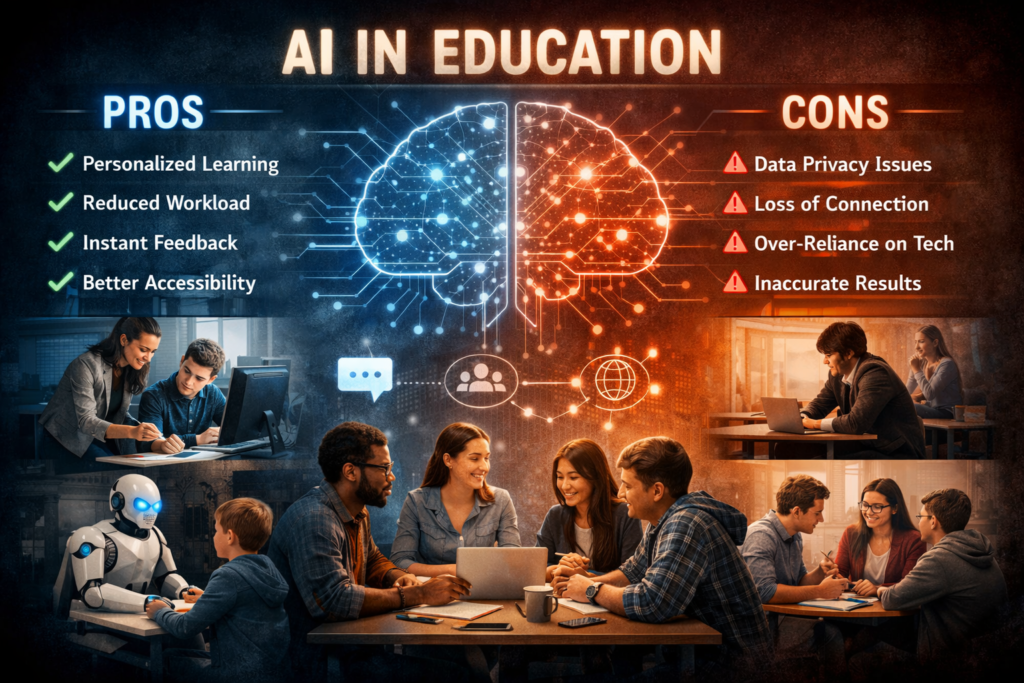
The Pros of AI in Education
Understanding the advantages helps paint a balanced picture of the pros and cons of AI in education.
Enhanced Personalized Learning
AI adapts to each student’s level, making learning more efficient and effective. This is one of the most celebrated aspects of the pros and cons of AI in education.
Reduced Teacher Workload
Teachers can automate administrative tasks, saving time and energy. This efficiency is a major point in favor when discussing the pros and cons of AI in education.
Immediate Student Feedback
Students receive instant feedback, helping them improve faster. This benefit stands out strongly in the pros and cons of AI in education.
Increased Accessibility
AI tools support students with disabilities through voice recognition, text-to-speech, and more—another important factor in the pros and cons of AI in education.
Better Use of Data
AI provides insights into student performance, enabling data-driven decisions. However, this also ties into privacy concerns within the pros and cons of AI in education.
Increasing Student Engagement
Interactive AI tools can make learning more engaging, though this depends heavily on implementation—again reflecting the balance in the pros and cons of AI in education.
Explore K-12 Educational Leadership Resources
Educational leaders must understand both sides of the pros and cons of AI in education to implement AI responsibly and effectively.
The Cons of AI in Education
While the benefits are compelling, the cons in the pros and cons of AI in education conversation are critical—and often underestimated.
Protecting Student Data
AI systems collect large amounts of data. Without proper safeguards, student privacy can be at risk. This is one of the biggest concerns in the pros and cons of AI in education.
Implementation Challenges
AI tools can be expensive and require training. Schools without resources may fall behind, widening inequality—another major issue in the pros and cons of AI in education.
Over-Reliance on Technology
Students may become too dependent on AI tools, reducing critical thinking skills. This is a growing concern within the pros and cons of AI in education.
Inaccurate or Misleading Outputs
AI is not perfect. It can generate incorrect information, which can mislead students—yet another risk in the pros and cons of AI in education.
The Biggest Hidden Con: Loss of Human Connection
One of the most overlooked aspects of the pros and cons of AI in education is the lack of real human interaction.
AI can personalize learning, but it cannot replace:
- Peer-to-peer discussions
- Group collaboration
- Emotional connection
- Real-world communication skills
Students don’t just learn from content—they learn from each other.
Without interaction:
- Creativity decreases
- Communication skills weaken
- Collaboration becomes harder
- Learning becomes isolated
This is where the pros and cons of AI in education become very real. Efficiency increases—but connection decreases.
Why Connection Matters in Learning
Education is not just about absorbing information. It’s about:
- Sharing ideas
- Working on projects together
- Learning from different perspectives
When students collaborate:
- They develop critical thinking
- They build confidence
- They learn teamwork
The pros and cons of AI in education clearly show that AI alone cannot provide this experience.
How Epicsellr Solves This Problem
While AI tools focus on automation, Epicsellr focuses on connection.
With built-in social networking features, Epicsellr allows students to:
- Connect with each other
- Share ideas and progress
- Collaborate on projects
- Express themselves in a learning community
This directly addresses one of the biggest gaps in the pros and cons of AI in education.
Instead of isolated learning, Epicsellr creates:
- Community-driven education
- Interactive learning environments
- Real student engagement
Should AI Be Used in Schools?
The answer is not simply yes or no. The pros and cons of AI in education make it clear that AI should be used carefully and intentionally.
AI works best when it:
- Supports teachers, not replaces them
- Enhances learning, not isolates students
- Automates tasks, not relationships
Schools that rely only on AI risk losing the human side of education.
Using AI in Schools — With Purpose and Intention
To truly balance the pros and cons of AI in education, schools need a hybrid approach:
- Use AI for efficiency
- Use human interaction for growth
- Use platforms like Epicsellr for connection
The future of education is not AI vs humans—it’s AI + human connection.
Final Thoughts
The pros and cons of AI in education reveal a powerful truth:
AI can make learning faster, smarter, and more accessible—but it cannot replace the human experience of learning together.
If schools focus only on AI:
- Learning becomes efficient but isolated
If schools combine AI with connection:
- Learning becomes powerful and meaningful
That’s where Epicsellr stands out.
By integrating social networking into education, Epicsellr ensures that students don’t just learn—they connect, collaborate, and grow together.
Ready to Build a More Connected Learning Experience?
AI can improve efficiency—but real learning happens through connection, collaboration, and community.
If you’re serious about overcoming the biggest gap in the pros and cons of AI in education—the lack of human interaction—it’s time to build a platform that brings students together.
With Epicsellr, you can:
- Create your own online school
- Enable student-to-student interaction
- Build a community with built-in social networking
- Encourage collaboration through shared learning experiences
Don’t just create courses.
Create a learning environment where students connect, share, and grow together.